25 Easy Tricks to Teach Your Dog (Step by Step)
Easy tricks to teach your dog, from shake, spin and high five to roll over, play dead and putting toys away, with simple steps and tips for every level.
· 7 min read
Teaching tricks isn’t just for show. A few minutes of trick training a day tires out busy brains, builds confidence in shy dogs, strengthens your bond, and makes everyday handling easier. And it’s fun for both of you.
Here are 25 easy tricks to teach your dog, from first-day basics to party pieces, with simple steps for each.
Before you start: how to teach any trick
- Use tiny, soft treats your dog loves, cut to pea size.
- Keep sessions short: 3–5 minutes, once or twice a day. Stop while your dog still wants more.
- Use a marker to tell your dog the exact moment they got it right: a clicker or a short “yes!”. Our clicker training guide explains how, and our online dog clicker works on your phone.
- Add the cue word last, once your dog does the trick reliably.
- Work on a non-slip surface like a rug or grass.
- Never force your dog into position. Lure with a treat or reward small steps instead.
Beginner tricks (1–10)
1. Touch (hand target)
Hold your flat palm a few inches from your dog’s nose. When they sniff it, mark and treat. Move your hand to new spots. Add “touch” once they bump it every time. It’s the base for many other tricks, and handy for recall.
2. Shake a paw
Hold a treat in a closed fist at your dog’s chest height. Wait. Most dogs paw at your hand: mark and open your hand. Then offer your open palm and mark when the paw lands on it. Add “shake” or “paw”.
3. High five
Once your dog knows shake, hold your palm up and slightly higher, fingers pointing up. Mark the paw touch. Add “high five”.
4. Spin
With a treat at your dog’s nose, lure them in a slow circle. Mark when they complete it, then treat. After a few reps, make the same circle motion without food. Add “spin”, then teach the other direction as “twist”.
5. Watch me
Hold a treat next to your eye. When your dog looks at your face, mark and treat. Gradually move the treat away so they look at your eyes, not the food. Great for focus on walks.
6. Bow
From a stand, move a treat from your dog’s nose down between their front paws and slightly back. Mark when the elbows dip while the rear stays up. If they lie down, mark earlier, when the front end first lowers.
7. Chin rest
Sit down and put your open hand on your knee. Lure your dog’s chin onto your hand with a treat from the other hand and mark the moment the chin rests. Build a few seconds. It’s calming and very useful at the vet.
8. Find it
Let your dog watch you toss a treat on the floor and say “find it!”. Then hide treats in easy places in the room, then harder ones. Sniffing is tiring and calming, perfect for rainy days.
9. Leave it and take it
Show a treat in your closed fist. Wait until your dog stops nosing your hand, mark and give a treat from the other hand. Then open your hand slowly; close it if they dive in. Add “leave it”, then release with “take it”. A trick that doubles as a safety skill.
10. Go to your mat
Click any step toward a mat, then paws on it, then lying on it, tossing treats off the mat so your dog can earn another. Add “mat” or “place”. Perfect when visitors arrive; see how to stop a dog from jumping.
Intermediate tricks (11–18)
11. Roll over
From a down, move a treat from your dog’s nose toward their shoulder so they roll onto their hip, then continue over their back. Mark each part at first: onto the hip, onto the side, all the way over. Teach it on a soft surface.
12. Play dead (“bang!”)
Start like roll over, but mark and treat when your dog is lying flat on their side. Build a few seconds of stillness. Add a finger-gun “bang!” as the cue.
13. Back up
Stand facing your dog in a narrow space, like a hallway. Step into them slowly. Mark any step backward and toss the treat behind them. Build to several steps, then add “back”. Good for body awareness.
14. Wave
Teach high five, then raise your hand a little higher so your dog paws the air without touching it. Mark that air paw. Add a wave of your hand as the cue.
15. Through the legs
Stand with your feet wide. Lure your dog through your legs from behind with a treat. Then try weaving in a figure eight as you walk slowly. Teach this to small and medium dogs.
16. Speak and quiet
Find something that makes your dog bark once, like a knock. Mark the bark, then wait for silence and mark that too. Add “speak” and “quiet”. Practice quiet more than speak; our barking guide explains why.
17. Jump through a hoop
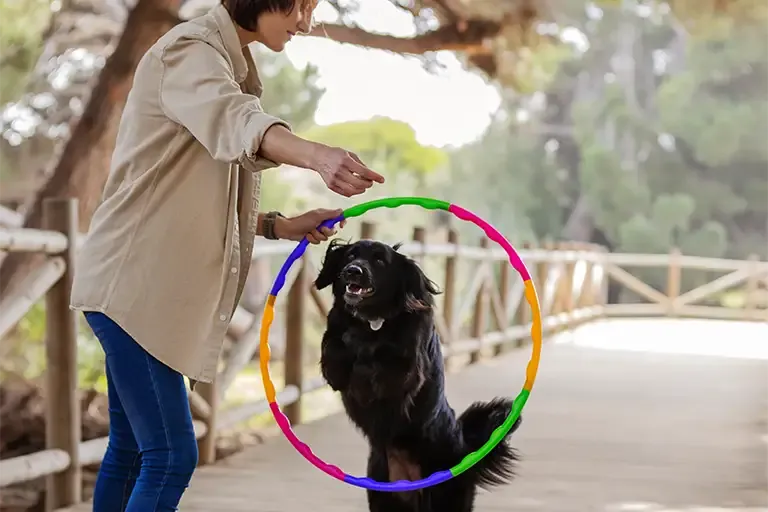
Hold a hoop on the floor and lure your dog through it. Raise it gradually, only a few inches at a time, and never higher than your dog can jump comfortably. Skip jumping for puppies and dogs with joint problems.
18. Crawl
From a down, hold a treat on the floor just in front of your dog’s nose and slowly draw it forward. Mark any forward shuffle while the elbows stay down. Build distance gradually.
Advanced tricks (19–25)
19. Put your toys away
Teach “drop it” over a basket: hold the basket under your dog’s mouth, mark when the toy falls in. Gradually move the basket further away, so your dog has to carry the toy to it. Add “tidy up”.
20. Ring a bell
Hang a bell at nose height. Mark any sniff or nudge of the bell. Once your dog rings it reliably, ring it before every trip outside, and many dogs learn to ask to go out. See our potty training guide.
21. Close the door
Stick a sticky note on a door that swings easily. Teach your dog to touch it with their nose (like hand target). Mark firmer pushes until the door closes. Add “close it”.
22. Fetch a named toy
Start with one toy. Say its name as you play with it and reward when your dog picks it up. Add a second toy and only reward picks of the named one. Some dogs learn the names of dozens of toys.
23. Peekaboo
Stand with your back to your dog and feet apart. Lure their head between your legs from behind and mark when the head pops through. Add “peekaboo”.
24. Say your prayers
With your dog sitting in front of a low chair or stool, teach paws up on it, then lure the nose down between the paws. Mark that moment. Good for calm, flexible adult dogs.
25. Take a bow and spin combo
Chain two tricks your dog already knows: “spin”, then “bow” before the reward. Chains look impressive and are a great challenge for clever breeds like Poodles and Border Collies.
Tricks for every kind of dog
| Dog | Good tricks | Avoid or adapt |
|---|---|---|
| Puppies | Touch, watch me, spin, find it, go to mat | Jumping tricks until fully grown |
| Seniors | Chin rest, find it, shake, touch, fetch a named toy | Jumping, rolling, standing on hind legs |
| Long-backed breeds (Dachshunds, Corgis, Basset Hounds) | Spin, touch, find it, bow | Sitting up, begging, high jumps |
| High-energy breeds | Chains, put toys away, back up, crawl | Endless repetition: keep it varied |
| Shy or anxious dogs | Touch, chin rest, find it | Pressure; let them choose to engage |
Troubleshooting
- Your dog gets frustrated or wanders off: the step is too big. Go back to the last thing they could do and mark smaller progress.
- Your dog only does the trick when you hold food: fade the lure after 5–6 reps and reward from the other hand.
- Your dog offers the wrong trick: that’s normal and a good sign they’re thinking. Don’t reward it; reset and make the new trick easier.
- Your dog won’t take treats: they’re too stressed or distracted. Move somewhere quieter.
Related guides and tools
- Clicker training for dogs: complete beginner’s guide
- Online dog clicker
- Dog training glossary
- How to stop puppy biting
Frequently asked questions
What is the easiest trick to teach a dog?
Hand target (“touch”), shake a paw and spin are usually the easiest. Most dogs learn them in one or two short sessions because they build on things dogs do naturally: sniffing a hand, lifting a paw and following a treat.
How long does it take to teach a dog a trick?
Simple tricks often take a few days of 3–5 minute sessions. More complex tricks like roll over, play dead or putting toys away can take a couple of weeks. Practice little and often, and stop while your dog is still having fun.
Can you teach an old dog new tricks?
Yes. Older dogs learn tricks well and benefit from the mental exercise. Choose tricks that are gentle on the body, like touch, chin rest, find it or shake, and skip jumping and rolling tricks for dogs with joint problems.
What tricks can I teach a puppy?
Start with eye contact, touch, sit, down, spin and find it. Keep sessions to 2–3 minutes, use tiny soft treats, and avoid jumping tricks until your puppy’s joints are fully grown (ask your vet when).
Should I use treats to teach tricks?
Yes. Small, soft treats are the fastest way to teach a trick. Once your dog knows it well, reward with a mix of treats, praise and play. Many dogs love doing tricks so much that the trick itself becomes rewarding.
How many tricks can a dog learn?
Far more than most people think. Many dogs know dozens of cues. Teach one new trick at a time, and keep practicing old ones so they don’t fade.
Note: This article is for general information and isn’t a substitute for advice from your veterinarian. Some links may be affiliate links; we may earn a commission at no extra cost to you.Written with AI assistance. Editorial review in progress. Last updated: . How we create our content