Dog Age Calculator by Breed
Find out how old your dog is in human years. Pick a breed or size, then enter their age, or their birthday for an exact age and a countdown to the next one. You get a size-adjusted result with life stage and care tips, more accurate than the old “×7” rule.
Last updated October 2026
In human years
36
Adult
In their prime. Yearly vet checks, dental care and weight management matter most.
- Old “×7” rule
- 35
- DNA-clock estimate*
- 57
- Typical lifespan
- 10–14 years
*Based on the 2020 UC San Diego epigenetic study of Labrador Retrievers (16 × ln(age) + 31). Only meaningful from age 1.
How old is my dog in human years?
A quick rule of thumb: a dog’s first year equals about 15 human years, the second year adds about 9 more (so a 2-year-old dog is about 24), and each year after that adds roughly 4–5 years for small dogs and 6–7 years for large and giant dogs, because bigger breeds age faster. For your dog’s exact figure, use the calculator above or find their age and size in the chart below.
Dog age chart: dog years to human years
This is the size-based chart the calculator uses, popularized by the American Veterinary Medical Association. Find your dog’s age on the left and their adult size along the top.
| Dog age | Small ≤20 lb | Medium 21–50 lb | Large 51–100 lb | Giant 100+ lb |
|---|---|---|---|---|
| 1 year | 15 | 15 | 15 | 12 |
| 2 years | 24 | 24 | 24 | 22 |
| 3 years | 28 | 28 | 28 | 31 |
| 4 years | 32 | 32 | 32 | 38 |
| 5 years | 36 | 36 | 36 | 45 |
| 6 years | 40 | 42 | 45 | 49 |
| 7 years | 44 | 47 | 50 | 56 |
| 8 years | 48 | 51 | 55 | 64 |
| 9 years | 52 | 56 | 61 | 71 |
| 10 years | 56 | 60 | 66 | 79 |
| 11 years | 60 | 65 | 72 | 86 |
| 12 years | 64 | 69 | 77 | 93 |
| 13 years | 68 | 74 | 82 | 100 |
| 14 years | 72 | 78 | 88 | 107 |
| 15 years | 76 | 83 | 93 | 114 |
| 16 years | 80 | 87 | 99 | 121 |
Highlighted values mark roughly when dogs of that size are considered seniors.
How dogs really age
Dogs race through childhood. By their first birthday most dogs are physically like a mid-teen human: sexually mature, nearly full-grown, and full of adolescent energy. Year two adds roughly another nine human years. After that the pace slows to about 4–7 human years per dog year, depending mostly on size.
That’s why a single multiplier can’t work. A 10-year-old Yorkshire Terrier is roughly 56 in human terms, while a 10-year-old Great Dane is closer to 80.
Breeds by size category
Not sure which size to choose? Here’s where common breeds usually fall, based on typical adult weight:
Small (up to 20 lb / 9 kg)
Affenpinscher, Bichon Frise, Border Terrier, Boston Terrier, Cairn Terrier, Cavalier King Charles Spaniel, Chihuahua, Dachshund, French Bulldog, Havanese, Italian Greyhound, Jack Russell Terrier, Lhasa Apso, Maltese, Miniature Pinscher, Miniature Schnauzer, Papillon, Pekingese, Pomeranian, Poodle (Miniature), Poodle (Toy), Pug, Shetland Sheepdog, Shiba Inu, Shih Tzu, West Highland White Terrier, Yorkshire Terrier. Typical lifespan: 12–16 years; senior from about 10 years.
Medium (21–50 lb / 10–23 kg)
American Staffordshire Terrier, Australian Cattle Dog, Australian Shepherd, Basenji, Basset Hound, Beagle, Border Collie, Brittany, Bull Terrier, Bulldog (English), Chow Chow, Cocker Spaniel, Corgi (Pembroke), Dalmatian, English Springer Spaniel, Labradoodle (standard), Pit Bull Terrier, Poodle (Standard), Samoyed, Siberian Husky, Staffordshire Bull Terrier, Standard Schnauzer, Vizsla, Whippet. Typical lifespan: 10–14 years; senior from about 8 years.
Large (51–100 lb / 23–45 kg)
Airedale Terrier, Akita, Alaskan Malamute, American Bulldog, Bernese Mountain Dog, Bloodhound, Boxer, Collie, Doberman Pinscher, German Shepherd, German Shorthaired Pointer, Golden Retriever, Goldendoodle (standard), Greyhound, Irish Setter, Labrador Retriever, Rhodesian Ridgeback, Rottweiler, Weimaraner. Typical lifespan: 9–12 years; senior from about 7 years.
Giant (over 100 lb / 45 kg)
Bullmastiff, Cane Corso, Great Dane, Great Pyrenees, Irish Wolfhound, Mastiff, Newfoundland, Saint Bernard. Typical lifespan: 7–10 years; senior from about 5 years.
Want breed-specific care tips? Read our profiles of the Labrador Retriever, German Shepherd, Beagle and Yorkshire Terrier.
Caring for your dog at every life stage
- Puppy (0–1 year): vaccinations, socialization before about 16 weeks, house training and crate training.
- Adolescent (1–2 years): energy peaks and training can seem to regress. Stay consistent and increase mental exercise.
- Adult: annual checkups, dental cleaning, and keeping a lean body weight, the single biggest lifespan factor you control.
- Senior: vet visits every six months, joint-friendly exercise, softer bedding, and watching for changes in thirst, appetite, weight or behavior.
This calculator gives an estimate for curiosity and care planning. It isn’t a medical assessment. Your vet can tell you how your individual dog is aging.
Frequently asked questions
Is 1 dog year really 7 human years?
No. The “multiply by 7” rule is a myth. Dogs mature very quickly: a 1-year-old dog is roughly like a 15-year-old teenager, and a 2-year-old is around 24. After that, aging slows, and the pace depends on size. Large and giant breeds age faster than small ones.
Is there a dog birthday calculator?
Yes. Switch the calculator to Birthday and enter your dog’s date of birth. You’ll see their exact age in years, months and days, their age in human years, and how many days until their next birthday.
How do I convert human years to dog years?
Switch the calculator to Human → dog years, pick a size and enter a person’s age. It works the chart backwards: for example, a 40-year-old person is roughly like a 6-year-old small dog but only a 4-year-old giant breed.
How many human years is 1 dog year?
A dog’s first year equals about 15 human years, and the second year adds about 9 more, so a 2-year-old dog is roughly 24. After that, each dog year equals about 4–5 human years for small dogs and 6–7 for large and giant breeds.
Why do large dogs age faster than small dogs?
Within a species, bigger animals usually live longer, but dogs are the exception. Researchers think rapid growth in large breeds is linked to earlier age-related disease. In practice, a Great Dane is a senior at 5–6, while a Chihuahua may not be considered senior until 10 or later.
How do I calculate my dog’s age by breed?
Choose your breed in the calculator above, or select the size that matches your dog’s adult weight, then enter their age. The calculator converts it with a size-specific chart. For mixed breeds, use your dog’s expected adult weight.
At what age is a dog considered a senior?
Roughly 10 for small dogs, 8 for medium, 7 for large and 5–6 for giant breeds. Many vets recommend twice-yearly checkups and senior bloodwork from that point.
How can I tell how old a rescue dog is?
A vet can estimate age from the teeth (wear, tartar, and whether adult teeth have come in), eye cloudiness, muzzle graying, muscle tone and joint stiffness. Puppies are easiest: adult teeth arrive by about 6–7 months. For adult dogs, the estimate is usually a range of a few years.
What is the DNA-based dog age formula?
A 2020 study from UC San Diego compared DNA methylation in Labradors and humans and proposed: human age = 16 × ln(dog age) + 31. It’s a fascinating result but was based on one breed. The size-based chart is still the more practical everyday guide.
Tool and guide written with AI assistance. Last updated: October 2026.How we create our content
Related guides
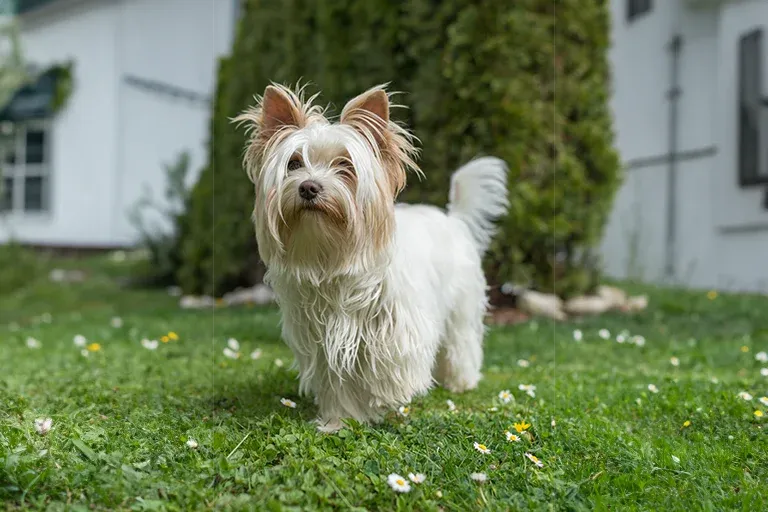
Yorkshire Terrier Breed Guide: Temperament, Types, Care & Health
Yorkshire Terrier guide: size, temperament, the types of Yorkies (teacup, parti, Biewer), grooming, health problems, training tips and whether one suits you.

Golden Retriever Breed Guide: Temperament, Care, Health & Training
Golden Retriever guide: temperament, size, American vs British vs Canadian types, exercise, shedding, cancer and health risks, training tips and costs.
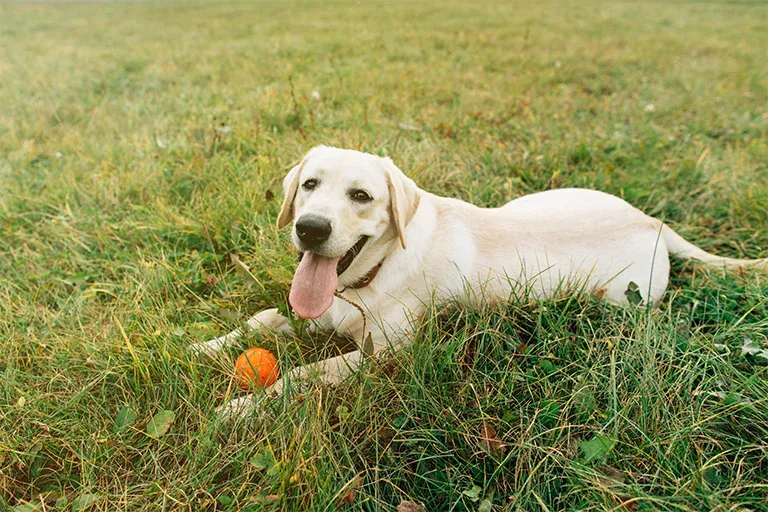
Labrador Retriever Breed Guide: Temperament, Exercise, Health & Care
Labrador Retriever guide: temperament, size, English vs American Labs, exercise, training, shedding, health problems like obesity, and the real costs.
More free dog tools
Sound Desensitization Player
Help your dog get used to fireworks, thunder and the doorbell.
Calming Music & Sounds for Dogs
Soft piano, brown noise, rain and heartbeat with a sleep timer.
Online Dog Clicker
A free training clicker with counter and session timer.
Dog Food Calculator
Daily calories and cups for your dog’s weight and age.
Puppy Weight Calculator
How big will your puppy get? Estimate adult weight.
Can My Dog Eat This? Food Checker
Search 100+ foods: safe, small amounts only, or toxic.
Dog Chocolate Toxicity Calculator
Did your dog eat chocolate? Check the risk in seconds.
Dog Name Generator
Find the perfect name by style, gender and personality.
Pet Behavior Analysis Tool
Answer a few questions to understand what drives a behavior.
Dog Whistle Frequency Simulator
Play adjustable high-frequency whistle tones in your browser.
Glossary for Dog Training
Plain-English definitions of common training terms.