How to Stop Your Dog From Jumping: Fences, People & Counters
How to stop a dog jumping: fence-proofing with extensions and coyote rollers, calm greetings so your dog stops jumping on people, and counter-surfing fixes.
· Updated · 6 min read
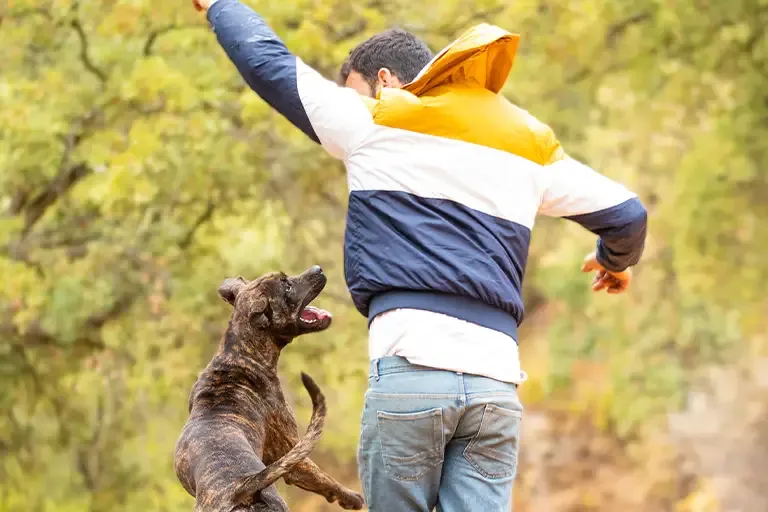
Jumping is one of the most common complaints dog owners have, but “jumping” covers very different problems. A dog leaping on guests is being over-friendly. A dog clearing the garden fence is a safety emergency. A dog with paws on the kitchen counter is a food thief.
Each has a different cause and a different fix. Jump to the one you need:
How to stop a dog from jumping the fence
A dog that escapes the yard is at risk from traffic, getting lost, fights and theft. Start with supervision: until you’ve solved it, don’t leave a fence-jumper alone outside.
Why do dogs jump fences?
Work out the motivation first, because blocking the escape without meeting the need often leads to digging or chewing through instead.
| Motivation | Typical signs | What helps |
|---|---|---|
| Boredom / under-exercise | Jumps when left out alone for long periods | More walks, play and enrichment; shorter unsupervised yard time |
| Social seeking | Jumps toward neighbors’ dogs, kids, people walking past | Company, playdates, block the view of the street |
| Prey drive | Chases squirrels, cats, deer over the fence | Visual barriers, management, recall training |
| Mating instinct | Unneutered dogs, especially males, roaming | Neutering, secure fencing |
| Fear | Escapes during storms, fireworks, construction | Bring indoors during triggers, safe den, vet advice on anxiety |
| Territorial | Charges the fence at passers-by and goes over | Block view, remove access to fence line |
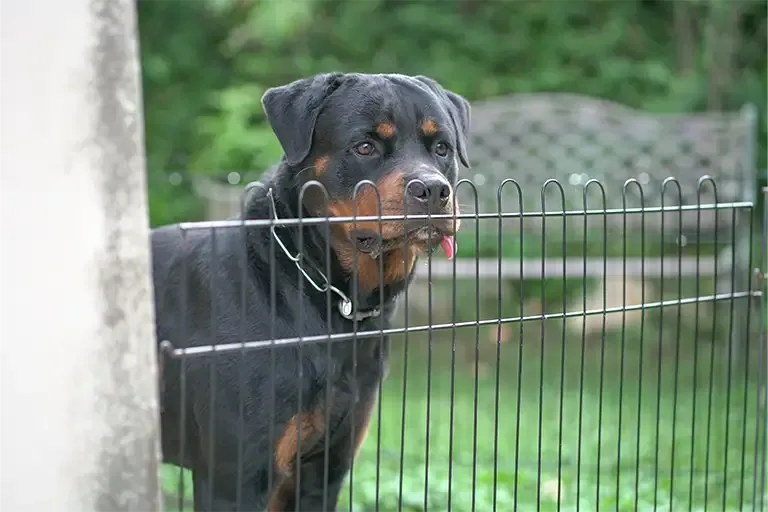
7 ways to make your fence jump-proof
- Add an inward-angled extension. Brackets angled 45° toward the yard, topped with wire or mesh, make it nearly impossible to get over. They’re cheaper than replacing the fence.
- Install coyote rollers. Spinning tubes along the top stop dogs who climb rather than clear the fence.
- Raise the height. Lattice panels or a mesh extension add 1–2 ft. Aim for at least 6 ft for large, athletic dogs.
- Remove launch pads. Move bins, benches, planters, woodpiles and garden furniture away from the fence. Many “jumpers” are actually climbers using a step.
- Remove footholds. Chain-link and horizontal rails work like ladders. Cover them with smooth panels or plastic sheeting on the inside.
- Block the view. Privacy slats, reed screening or hedges remove the trigger for dogs who jump at what they see.
- Add an inner barrier. A low inner fence or dense planting 2–3 ft inside the main fence stops dogs getting a run-up.
Avoid electric and invisible fences. They rely on discomfort, don’t stop determined dogs, and can create fear or aggression toward whatever is on the other side.
Training to reduce fence jumping
- Recall from the fence. Practice calling your dog away from the fence line on a long line, rewarding heavily, before they’re over threshold.
- Teach “leave it” for squirrels and passing dogs.
- Reward calm. Toss treats when your dog sees a trigger and stays put.
- Meet the need. Two good walks a day, play sessions and food puzzles make the other side of the fence less tempting.
How to stop a dog from jumping on people
Dogs greet face-to-face, and puppies learn early that jumping gets them noticed. Every time someone pets, pushes or even says “no” to a jumping dog, the jump gets attention. The goal is to make four paws on the floor the only thing that earns a greeting.
Step by step
- Manage greetings. Use a leash, baby gate or crate when guests arrive so your dog can’t practice jumping while you train.
- Remove the reward. When your dog jumps, turn your back and fold your arms. No eye contact, no talking.
- Reward the alternative. The moment all four paws touch the floor, turn around and calmly praise or give a treat. If they jump again, turn away again.
- Teach an incompatible behavior. A dog can’t sit and jump at the same time. Practice sit at the door dozens of times, without guests at first.
- Keep greetings low-key. Excited voices fuel jumping. Greet your dog calmly when you come home.
- Recruit your guests. Ask them to follow the same rules. One person who encourages jumping undoes a lot of work.
- Use the “treat scatter.” As someone walks in, toss a handful of small treats on the floor. Your dog’s nose goes down instead of up.
Most dogs improve noticeably within 2–3 weeks of consistent practice. Expect a short “extinction burst” where jumping briefly gets worse as your dog tests whether it still works.
Jumping on strangers during walks
Keep your dog on a short leash as people approach, ask for a sit, and reward. If your dog is too excited to sit, increase the distance and practice where people are farther away. Don’t let people greet your dog until they’re calm.
How to stop a dog from jumping on counters
Counter-surfing is self-rewarding: it only takes one stolen sandwich to make it a lifelong hobby.

- Clear the counters completely. For several weeks, nothing edible is left within reach, not even for a minute.
- Teach “place.” Train your dog to lie on a mat while you cook, and reward them regularly for staying.
- Block the kitchen with a gate when you can’t supervise.
- Reward four paws on the floor in the kitchen.
- Don’t punish after the fact. If you come home to an empty bread bag, your dog can’t connect your anger to something they did earlier.
How to stop a dog from jumping on the couch
If you’re happy to share the sofa, there’s no harm in it. If you’re not, be consistent: dogs can’t understand “sometimes allowed.”
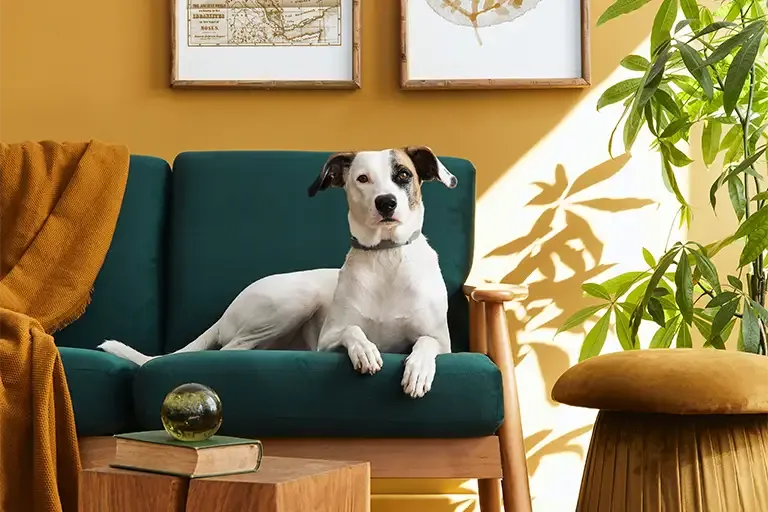
- Give your dog a comfy bed of their own next to the couch, and reward them for using it.
- Teach “off” by luring with a treat to the floor, then reward.
- Block access when you’re out, with closed doors or upturned cushions.
- Or teach “on” and “off” cues so the couch is by invitation only.
Why exercise matters for every kind of jumping
A dog with pent-up energy jumps more: at people, at counters and over fences. Daily exercise matched to your dog’s breed and age, plus mental work like sniffing games and short training sessions, reduces jumping across the board. Herding and working breeds often need far more than a quick walk round the block.
What not to do
- Don’t knee, push or step on toes. It can injure your dog and often adds excitement.
- Don’t yell. To an excited dog, shouting is attention.
- Don’t rely on shock collars or electric fences. They suppress behavior through pain and can create fear-based problems.
Related guides and tools
- Free online dog whistle with recall signals
- Pet behavior analysis tool
- How to stop your dog digging under the fence
- How to stop excessive barking
Frequently asked questions
Why does my dog keep jumping the fence?
Dogs jump fences to get to something (other dogs, wildlife, people, a mate) or to get away from something (boredom, loneliness, fear of storms or fireworks). Once a dog succeeds, the escape itself becomes rewarding, so it happens again. Fix it with physical barriers plus meeting the underlying need.
How high does a fence need to be to stop a dog jumping?
For most medium dogs, 5 feet (1.5 m) is a minimum; for large, athletic breeds like Huskies, Shepherds and Malinois, 6 feet (1.8 m) or more. Height matters less than design: an inward-angled top, coyote rollers, or a smooth surface without footholds stops many determined jumpers.
What are coyote rollers?
Coyote rollers are spinning tubes mounted along the top of a fence. When a dog gets its paws on top to climb over, the roller spins and they can’t get a grip. They’re humane and very effective for climbers.
Should I use an electric fence to stop fence jumping?
We don’t recommend it. Invisible and electric fences rely on pain, can increase fear and aggression, and many dogs simply run through when motivated. Physical barriers and training are safer and more reliable.
How do I stop my dog jumping on guests?
Put your dog on a leash or behind a gate when guests arrive, ask guests to ignore jumping and greet only when four paws are on the floor, and reward sits generously. Scatter a few treats on the floor as people enter to keep your dog’s nose down.
Is it OK to knee my dog when it jumps up?
No. Kneeing, stepping on toes or pushing can injure your dog and often makes jumping more exciting, or more anxious. Removing attention and rewarding an alternative behavior works better and lasts.
Note: This article is for general information and isn’t a substitute for advice from your veterinarian. Some links may be affiliate links; we may earn a commission at no extra cost to you.Written with AI assistance. Editorial review in progress. Last updated: . How we create our content