Puppy Weight Calculator
How big will your puppy get? Enter your puppy’s age, current weight and breed or size. You’ll get an estimated adult weight range, a growth chart, when your puppy will be full-grown, and the crate size to buy.
Last updated October 2026
Likely 17 kg–21 kg when full-grown
Your puppy is about 32% grown and should reach adult weight at around 15 months.
- At 4 months
- 8.6 kg
- At 6 months
- 13 kg
- At 1 year
- 18 kg
An estimate, not a guarantee. Genetics, sex, diet and neutering all play a part. Ask your vet if your puppy seems to be growing too fast or too slowly.
How the puppy weight calculator works
Puppies don’t grow at a steady rate: they grow fastest in the first months, then slow down. Small breeds also finish growing much earlier than large breeds. The calculator compares your puppy’s current weight with typical growth curves for its size class, works out what share of adult weight it has probably reached, and estimates the adult weight from that.
Puppy growth chart by size
Typical percentage of adult weight reached at each age:
| Age | Toy | Small | Medium | Large | Giant |
|---|---|---|---|---|---|
| 8 weeks | 25% | 22% | 18% | 14% | 11% |
| 12 weeks | 40% | 37% | 32% | 24% | 19% |
| 16 weeks | 55% | 51% | 46% | 34% | 27% |
| 6 months | 78% | 74% | 66% | 53% | 43% |
| 7 months | 92% | 88% | 80% | 68% | 57% |
| 9 months | 98% | 96% | 89% | 79% | 68% |
| 13 months | 100% | 100% | 98% | 92% | 84% |
| 17 months | 100% | 100% | 100% | 98% | 93% |
Approximate values based on published puppy growth research and veterinary growth charts. Individual puppies vary by roughly ±10–15%.
Tips for healthy growth
- Feed for your puppy’s adult size. Large-breed puppy foods control calcium and energy to support slower, healthier growth.
- Keep your puppy lean. You should be able to feel the ribs easily. Use the dog food calculator to set portions.
- Weigh regularly. Every 2–4 weeks is enough; a sudden stall or spurt is worth mentioning to your vet.
- Go easy on joints. Avoid long runs and lots of jumping until growth plates close, especially in large breeds.
- Buy gear that grows. Choose a crate for the adult size with a divider, and an adjustable harness.
Next steps for new puppy owners: crate training, potty training and finding a name. Curious how old your dog is in human years? Try the dog age calculator.
Frequently asked questions
How big will my puppy get?
Enter your puppy’s age, current weight and expected size above. The calculator compares your puppy with typical growth curves for that size and estimates the adult weight as a range. Accuracy improves as your puppy gets older: estimates at 16 weeks and beyond are more reliable than at 8 weeks.
When do puppies stop growing?
Toy and small breeds usually reach adult weight at around 11–11 months, medium breeds around 15 months, large breeds at 18–15 months and giant breeds as late as 18–24 months. Many keep filling out (muscle and chest) for a few more months.
Do big paws mean a big dog?
Somewhat. Puppies with large paws relative to their legs often have more growing to do, but it’s not a reliable predictor on its own. The parents’ size is a much better guide.
Is there a simple rule of thumb?
A rough one for medium breeds is to double the weight at 16 weeks (4 months). For small breeds, weight at 6 months is often around 75% of adult weight. These rules are less accurate than using a growth curve for the right size, which is what this calculator does.
My puppy is a mixed breed. Will this work?
Yes, as long as you choose the expected adult size. If you don’t know, start with your best guess. If the result lands in a different size range, the calculator tells you, and you can try again with that size.
Can I make my puppy grow faster or bigger?
No, and you shouldn’t try. Overfeeding, especially in large and giant breeds, increases the risk of hip and elbow problems. Feed a puppy food made for your dog’s expected adult size and keep your puppy lean. Our dog food calculator can help.
Related guides
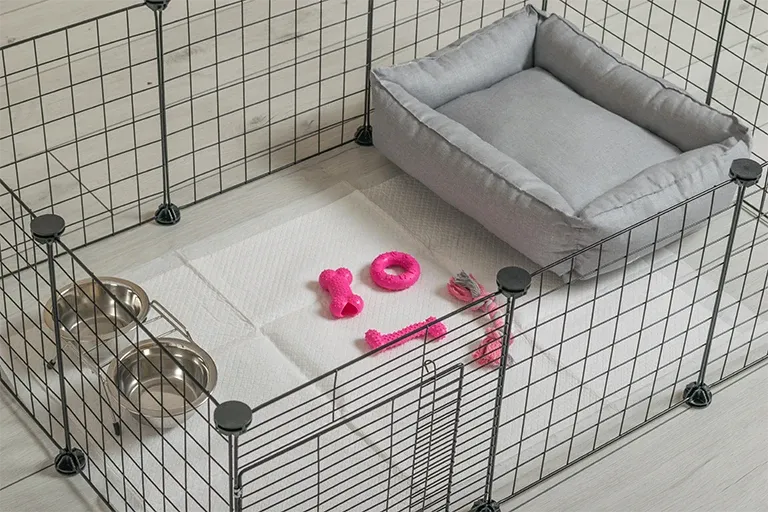
Crate Training a Puppy: Step-by-Step Guide That Works
How to crate train a puppy with positive reinforcement: a step-by-step process, an age-based crate time schedule, common mistakes, and how to handle crying.
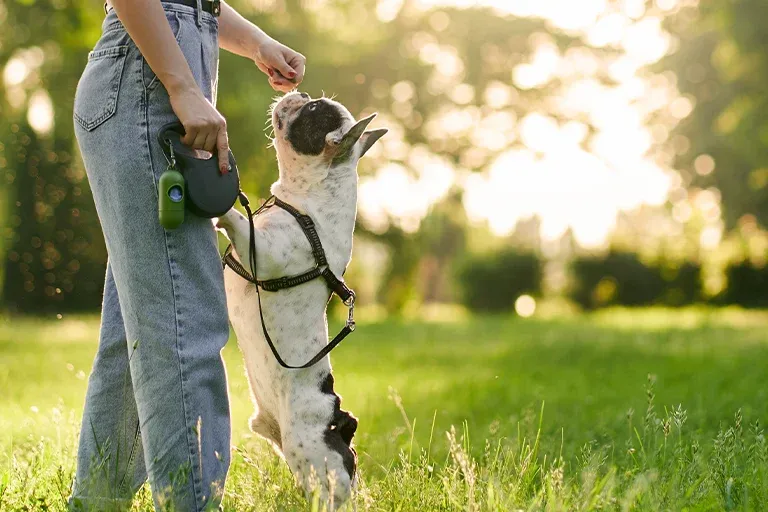
Leash Training a Puppy: Step-by-Step Guide to Loose-Leash Walking
How to leash train a puppy: get them used to the harness, teach loose-leash walking step by step, and fix pulling, leash biting, lunging and refusing to walk.
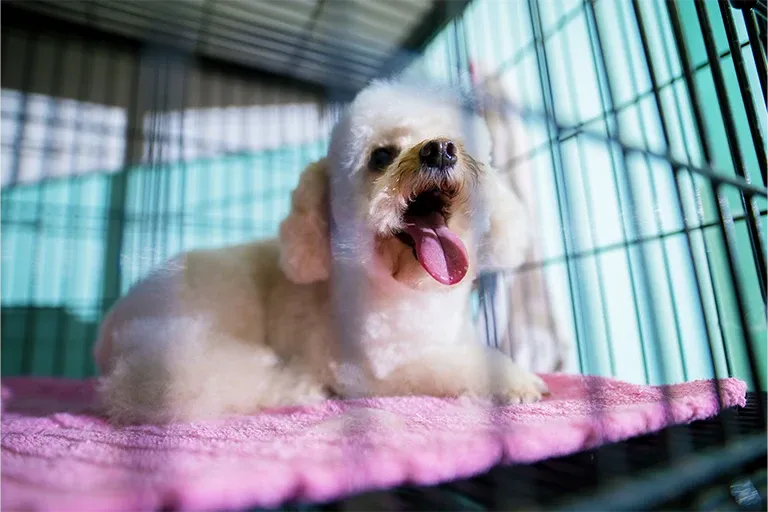
How to Choose a Dog Crate: Size Chart, Types & Setup Tips
How to choose a dog crate: measure your dog, use our crate size chart by breed, compare wire, plastic, wooden and heavy-duty crates, and set it up right.
More free dog tools
Sound Desensitization Player
Help your dog get used to fireworks, thunder and the doorbell.
Online Dog Clicker
A free training clicker with counter and session timer.
Dog Age Calculator by Breed
Convert your dog’s age to human years, adjusted for size.
Dog Food Calculator
Daily calories and cups for your dog’s weight and age.
Dog Chocolate Toxicity Calculator
Did your dog eat chocolate? Check the risk in seconds.
Dog Name Generator
Find the perfect name by style, gender and personality.
Pet Behavior Analysis Tool
Answer a few questions to understand what drives a behavior.
Dog Whistle Frequency Simulator
Play adjustable high-frequency whistle tones in your browser.
Glossary for Dog Training
Plain-English definitions of common training terms.